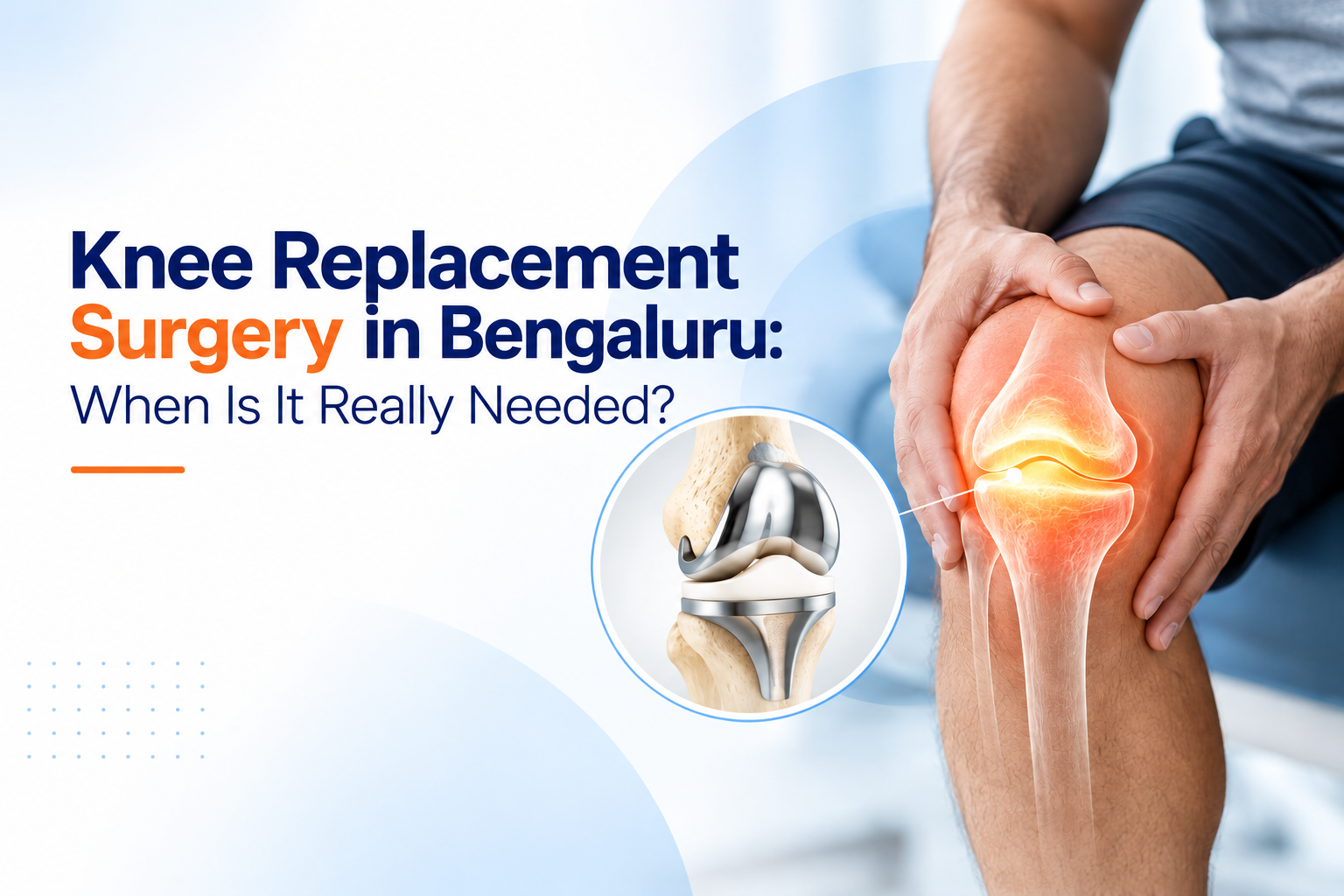
“Knee replacement” can sound like a major and frightening decision.
Many patients who have severe knee pain ask:
“Doctor, do I really need knee replacement?”
“Can I avoid surgery?”
“My X-ray shows severe arthritis. Does that mean I need an operation?”
“Should I wait until the pain becomes unbearable?”
“What happens if I keep delaying the surgery?”
“Will I be able to walk normally after knee replacement?”
These are important questions.
Knee replacement can significantly reduce pain and improve mobility and daily function in appropriately selected patients with advanced knee arthritis. But knee replacement is not automatically required just because an X-ray shows arthritis.
The decision should consider the complete picture:
Pain + function + examination + imaging + previous treatment + overall health + quality of life.
Current clinical guidance similarly emphasizes that joint replacement is generally considered when symptoms and functional limitations substantially affect quality of life and appropriate non-surgical treatments have not provided adequate relief.
The approach should be simple:
Treat conservatively when appropriate. Consider knee replacement when the knee problem is significantly affecting your life and suitable non-surgical treatments are no longer providing adequate relief.
What Is Knee Arthritis?
The knee is a complex joint formed mainly by the:
- Femur, or thigh bone
- Tibia, or shin bone
- Patella, or kneecap
The ends of these bones are covered with smooth cartilage that allows the joint to move with minimal friction.
With osteoarthritis, the cartilage and other structures of the joint gradually deteriorate.
As the joint becomes more damaged, patients may experience:
- Knee pain
- Stiffness
- Swelling
- Reduced movement
- Difficulty walking
- Difficulty climbing stairs
- Pain while standing for long periods
- Difficulty getting up from a chair
- Reduced ability to exercise
- Pain during or after activity
- In advanced cases, pain even while resting or sleeping
Osteoarthritis is the most common reason people undergo knee replacement. Other forms of arthritis or previous knee injury can also damage the joint and eventually lead to replacement surgery.
Why Does Knee Arthritis Become So Painful?
Patients sometimes imagine arthritis simply as “wear and tear.”
The reality is more complicated.
As the knee joint becomes damaged, several changes can contribute to symptoms.
The joint may develop:
- Cartilage loss
- Inflammation
- Bone changes
- Reduced joint space
- Stiffness
- Altered alignment
- Muscle weakness
- Reduced movement
This can change the way forces pass through the knee.
Over time, activities that were previously simple can become increasingly difficult.
For example:
Walking 5 kilometres → walking 2 kilometres → walking 500 metres → walking around the house becomes painful.
This gradual loss of function is one of the reasons doctors look beyond the X-ray when considering knee replacement.
What Are the Symptoms of Advanced Knee Arthritis?
Knee arthritis can affect people differently.
Some patients have significant X-ray changes but relatively manageable symptoms.
Others may have symptoms that severely affect their daily life.
Common symptoms include:
1. Pain while walking
You may notice pain after walking for a certain distance.
Over time, that distance may become shorter.
2. Difficulty climbing stairs
Going up or down stairs may become increasingly painful.
Some patients begin avoiding stairs completely.
3. Difficulty getting up from a chair
Activities such as getting up from a low chair, sofa or toilet may become difficult.
4. Knee stiffness
The knee may feel stiff after sitting or resting.
5. Swelling
Some patients experience recurrent swelling around the knee.
6. Reduced knee movement
You may find it difficult to fully bend or straighten the knee.
7. Night pain
Advanced arthritis may cause pain that interferes with sleep.
8. Knee deformity or change in alignment
Some patients develop a noticeable change in the shape or alignment of the leg.
9. Knee giving way
Some people feel that the knee is unstable or may give way while walking.
10. Reduced quality of life
This is perhaps the most important symptom.
You may stop:
- Going for walks
- Travelling
- Playing with grandchildren
- Exercising
- Going shopping
- Using stairs
- Participating in social activities
At this stage, the question becomes bigger than “How bad is my knee?”
It becomes:
“How much is my knee preventing me from living normally?”
Does Every Patient With Knee Arthritis Need Replacement?
No.
This is one of the most important points patients should understand.
A diagnosis of knee arthritis does not automatically mean knee replacement.
Treatment depends on:
- Severity of symptoms
- Degree of functional limitation
- Physical examination
- X-ray findings
- Other health conditions
- Previous treatments
- Response to treatment
- Patient expectations and goals
Many patients with knee arthritis can be managed without surgery, particularly when symptoms are manageable and function remains acceptable. Exercise, weight management, appropriate medication, physiotherapy and selected injections may all have a role depending on the individual patient.
What Can Be Tried Before Knee Replacement?
Before considering replacement, an orthopaedic specialist may discuss non-surgical options.
1. Exercise and strengthening
Appropriate exercise can help maintain:
- Muscle strength
- Joint mobility
- Balance
- General fitness
- Functional ability
Many patients avoid exercise because they believe movement will damage their knee further.
But complete inactivity can contribute to muscle weakness and stiffness.
The type and intensity of exercise should be appropriate for the individual’s condition.
2. Physiotherapy
Physiotherapy may help improve:
- Knee movement
- Quadriceps strength
- Hip strength
- Balance
- Walking pattern
- Functional ability
A rehabilitation programme should be tailored to the patient’s symptoms rather than copied from a generic exercise programme.
3. Weight management
Body weight can influence the mechanical load placed on the knee.
For patients who are overweight, appropriate weight management may help reduce symptoms and improve overall health.
This does not mean that every patient needs to lose a specific amount of weight before treatment.
It means weight and general health should be considered as part of comprehensive knee care.
4. Medication
Depending on the patient’s medical history, doctors may recommend appropriate pain-relieving or anti-inflammatory medication.
Medication should be selected based on individual health factors, because medicines that are safe for one patient may not be appropriate for another.
5. Injections
Selected patients may be considered for injections to help manage knee pain.
The type of injection and expected benefit depend on the diagnosis and individual situation.
An injection is not necessarily a permanent solution and should not automatically be viewed as an alternative to replacement when advanced arthritis is significantly affecting quality of life.
So When Is Knee Replacement Actually Considered?
This is the question most patients want answered.
Knee replacement may be considered when several factors come together.
1. Persistent knee pain
Pain continues despite appropriate treatment.
2. Significant functional limitation
The knee is affecting:
- Walking
- Stairs
- Work
- Exercise
- Travel
- Household activities
- Sleep
- Social activities
3. Advanced joint damage
Examination and imaging show significant arthritis that corresponds with the patient’s symptoms.
4. Non-surgical treatment is no longer providing adequate relief
You have already tried appropriate options, but the improvement is insufficient.
5. Quality of life is significantly affected
You are changing your lifestyle because of your knee.
This is an important point.
Knee replacement is not simply an X-ray decision.
It is a pain and function decision supported by clinical and imaging findings.
NICE guidance similarly describes referral for knee surgery around the substantial impact of pain, stiffness and reduced function on quality of life, particularly when appropriate non-surgical options have been tried and have not provided adequate relief.
The Most Important Question Is Not “How Bad Is My X-Ray?”
Patients often arrive with an X-ray and say:
“Doctor, the cartilage is completely gone. I need a replacement, right?”
Not necessarily.
The X-ray is important, but it is only one part of the assessment.
An orthopaedic surgeon also needs to understand:
How much pain are you actually experiencing?
How far can you walk?
Can you climb stairs?
Can you get up from a chair?
Can you sleep comfortably?
Can you travel?
Can you exercise?
Are you able to perform your normal activities?
Have you tried appropriate non-surgical treatment?
Does the X-ray finding actually explain your symptoms?
Are you medically fit for surgery?
Can You Delay Knee Replacement?
Sometimes, yes.
If your symptoms are manageable and you are still functioning reasonably well, there may be no reason to rush into surgery.
You may continue with appropriate non-surgical treatment and monitoring.
But there is another side to this.
You do not have to wait until your knee becomes unbearable.
Some patients keep postponing surgery for years because they believe:
“I should tolerate it a little longer.”
If pain has become severe and your daily life is significantly restricted despite appropriate treatment, continuing to live with severe symptoms indefinitely may not be beneficial.
There is no universal rule saying that you must reach a particular age or a particular pain score before having knee replacement.
The timing should be individualized.
Is There a “Best Age” for Knee Replacement?
No single age is right for everyone.
Patients often ask:
“Am I too young for knee replacement?”
or:
“Am I too old for knee replacement?”
Age is important, but it is not the only factor.
The decision also depends on:
- Severity of arthritis
- Pain
- Functional limitations
- General health
- Activity level
- Other medical conditions
- Previous treatments
- Expected benefit
- Surgical fitness
A younger patient with severe arthritis and major functional limitations may eventually require replacement.
An older patient with significant arthritis but manageable symptoms may not need surgery immediately.
Therefore, knee replacement should not be recommended simply because someone has reached a particular age.
What Happens If You Keep Delaying Surgery?
There is no universal answer.
Some patients remain reasonably functional for years with non-surgical treatment.
Others experience progressive pain and loss of mobility.
One concern with living with severe knee arthritis for a long time is that patients may gradually become less active.
Less activity can lead to:
Pain → less walking → muscle weakness → reduced confidence → even less activity.
This can make rehabilitation and recovery more challenging.
That does not mean that everyone with arthritis should undergo surgery early.
It means that severe, persistent symptoms should be reassessed rather than simply ignored.
What Is a Total Knee Replacement?
A Total Knee Replacement, also called Total Knee Arthroplasty, involves replacing damaged joint surfaces with artificial components.
The damaged surfaces of the femur and tibia are prepared and replaced with prosthetic components.
Depending on the surgical plan, the underside of the kneecap may also be treated.
The objective is to:
- Reduce pain
- Improve mobility
- Improve knee function
- Correct appropriate deformity
- Help the patient return to useful daily activities
A knee replacement is not designed to create a completely “new natural knee.”
The goal is to create a functional knee with substantially less pain and improved movement.
Knee replacement involves replacing damaged surfaces with artificial metal and plastic components, and total or partial replacement may be selected depending on the pattern of joint damage.
What Is Partial Knee Replacement?
A Partial Knee Replacement, also called unicompartmental knee replacement, replaces only the damaged compartment of the knee.
The knee has three main compartments:
- Medial compartment
- Lateral compartment
- Patellofemoral compartment
If arthritis is limited to one compartment and the rest of the knee is suitable, partial replacement may be an option for selected patients.
But partial replacement is not simply “a smaller version” of total knee replacement.
Patient selection is important.
The surgeon may consider:
- Which compartment is damaged
- Condition of the remaining compartments
- Ligament function
- Knee alignment
- Range of motion
- Stability
- Overall condition of the knee
NICE guidance recognizes partial and total knee replacement as options for appropriately selected patients with isolated compartmental osteoarthritis.
Total vs Partial Knee Replacement
| Feature | Total Knee Replacement | Partial Knee Replacement |
| Area treated | More extensive arthritis | One suitable compartment |
| Amount of joint replaced | More extensive | More limited |
| Patient selection | Suitable for a wider range of advanced arthritis patterns | More selective |
| Recovery | Individual and procedure-dependent | May be quicker for some patients |
| Suitability | Depends on overall knee condition | Requires appropriately localized disease |
| Main goal | Reduce pain and improve function | Reduce pain while preserving suitable parts of the knee |
Which one is better?
There is no universal answer.
Partial is not automatically better because it is smaller.
Total is not automatically better because it replaces more.
The right operation is the one that matches the actual condition of your knee.
How Does a Doctor Decide Which Knee Replacement You Need?
A proper knee replacement consultation involves much more than looking at an X-ray.
Step 1: Understand your symptoms
The doctor may ask:
- Where exactly is the pain?
- How long have you had it?
- Is it worse while walking?
- Is there pain at rest?
- Does it disturb sleep?
- Can you climb stairs?
- Can you walk outdoors?
- Can you exercise?
Step 2: Understand your functional limitations
The doctor may ask:
- How far can you walk?
- Can you get up from a chair?
- Can you use stairs?
- Can you travel?
- Can you perform household activities?
Step 3: Review previous treatment
The doctor may ask whether you have tried:
- Physiotherapy
- Exercise
- Medication
- Weight management
- Injections
- Activity modification
And importantly:
Did these treatments actually help?
Step 4: Examine the knee
The examination may assess:
- Range of motion
- Alignment
- Stability
- Tenderness
- Swelling
- Muscle strength
- Walking pattern
Step 5: Review imaging
X-rays are commonly used to assess:
- Joint-space narrowing
- Alignment
- Bone changes
- Distribution of arthritis
- Overall severity
Additional imaging may be required in selected situations.
The decision comes from putting all of these pieces together, not from one image alone.
Does an X-Ray Alone Decide Whether I Need Knee Replacement?
No.
This is worth repeating.
A severely arthritic X-ray does not automatically mean you need surgery.
At the same time, a patient should not ignore significant symptoms simply because they are afraid of surgery.
The important question is:
“How is the condition affecting your life, and is the knee actually responsible for those symptoms?”
Clinical assessment remains important when deciding whether joint replacement is appropriate.
What Happens During Knee Replacement Surgery?
If knee replacement is recommended, your orthopaedic surgeon will explain the procedure and preparation required.
In general, surgery involves:
- Preparing the damaged joint surfaces.
- Removing the damaged portions of bone and cartilage.
- Positioning the artificial components.
- Checking knee alignment and movement.
- Closing the surgical wound.
- Starting postoperative recovery and rehabilitation.
The exact surgical technique depends on the patient’s anatomy, knee condition and surgeon’s plan.
What Happens After Knee Replacement?
Recovery does not end when the surgery is completed.
Rehabilitation is an important part of the result.
Patients commonly begin movement and assisted walking soon after surgery, depending on their individual condition and surgical plan.
Initially, you may need:
- Walking assistance
- Physiotherapy
- Pain management
- Home exercises
- Gradual increase in activity
Over time, the focus shifts toward:
- Improving strength
- Improving knee movement
- Improving walking confidence
- Returning to daily activities
- Gradually increasing functional activity
Recovery varies significantly between individuals.
Some patients progress quickly, while others require more time.
Full recovery can take several months or longer.
Can You Walk After Knee Replacement?
In many cases, patients begin walking with assistance soon after surgery.
Initially, walking may involve:
- A walker
- Crutches
- A walking stick
The support is gradually reduced as strength, balance and confidence improve.
The goal is not simply:
“Can I walk?”
The goal is:
“Can I walk safely and comfortably and return to my normal activities?”
Can You Climb Stairs After Knee Replacement?
Many patients can return to climbing stairs after recovery.
However, the timing and ease of stair climbing vary.
Your rehabilitation programme will usually progress gradually.
Early rehabilitation may focus on:
- Basic movement
- Walking
- Muscle activation
- Knee bending and straightening
- Balance
Later, rehabilitation can progress toward more demanding activities.
Can You Exercise After Knee Replacement?
Many patients can return to suitable low-impact activities after recovery.
Examples may include activities recommended by the treating team based on individual recovery.
However, exercise should be introduced progressively.
The goal is not to immediately return to every activity you performed before surgery.
The goal is to build:
Movement → strength → confidence → function → appropriate activity.
How Long Does a Knee Replacement Last?
Modern knee replacements can provide long-term improvement.
The lifespan of an implant varies between individuals and depends on factors such as:
- Age
- Activity level
- Body weight
- Implant design
- Surgical technique
- Overall health
- Individual factors
This is why implant longevity should be discussed with your orthopaedic surgeon based on your specific situation.
What Are the Risks of Knee Replacement?
Knee replacement is a major surgical procedure, so patients should understand both its benefits and risks.
Potential complications can include:
- Infection
- Blood clots
- Bleeding
- Stiffness
- Persistent pain
- Instability
- Problems with wound healing
- Nerve or blood-vessel injury
- Implant-related problems
- Need for further surgery in selected cases
Most patients experience improvement in pain and daily function, but surgery cannot guarantee that every symptom will disappear completely.
Your surgeon should discuss the individual risks and benefits before surgery.
Should You Be Afraid of Knee Replacement?
It is normal to feel anxious about surgery.
But fear should not be the only reason to postpone an operation when your knee is significantly affecting your life.
At the same time, you should not feel pressured into surgery simply because an X-ray looks severe.
The right decision requires a proper discussion.
Ask:
What is causing my pain?
How advanced is my arthritis?
What other treatments are available?
Have we tried the appropriate non-surgical options?
What would happen if I wait?
What would I realistically gain from surgery?
Would I need a total or partial replacement?
What will recovery involve?
These questions can help you make an informed decision.
Knee Replacement for Active Adults
Knee replacement is not only about older patients sitting at home.
Many people want to remain active as they age.
They may want to:
- Walk regularly
- Travel
- Spend time with family
- Play with grandchildren
- Exercise
- Attend social events
- Work comfortably
- Maintain independence
When severe arthritis starts preventing these activities despite appropriate treatment, it may be reasonable to discuss knee replacement.
The goal is not simply to replace a damaged joint.
The goal is to improve function and quality of life.
Knee Replacement for Bengaluru Patients
If you are searching for Knee Replacement Surgery in Bengaluru, Knee Replacement in HSR Layout, or a Knee Replacement Surgeon in Bengaluru, the first step should not automatically be booking surgery.
The first step is determining:
Do you actually need a knee replacement?
Patients from:
- HSR Layout
- Koramangala
- BTM Layout
- Harlur
- Agara
- Bommanahalli
- Kudlu
- Sarjapur Road
- Bellandur
- Nearby areas of Bengaluru
may seek specialist evaluation for:
- Knee arthritis
- Severe knee pain
- Knee stiffness
- Difficulty walking
- Knee deformity
- Sports-related knee problems
- Meniscus injuries
- Ligament injuries
- Advanced knee degeneration
- Knee replacement consultation
At Omega Ortho Spine & Pain Care Centre, HSR Layout, Bengaluru, treatment should be based on the patient’s symptoms, examination, imaging and functional requirements.
Conservative treatment can be considered when appropriate. Knee replacement can be discussed when symptoms and functional limitations become significant and other suitable treatments are no longer providing adequate relief. Omega Blog Articles (1)
Meet Dr. Kiran Tej Daggupati
Dr. Kiran Tej Daggupati
Orthopaedic & Spine Surgeon
Minimally Invasive Spine Specialist
Omega Ortho Spine & Pain Care Centre
504, 22nd Cross Road, HSR Layout,
Bengaluru, Karnataka 560102
Appointments: 097435 47999
Dr. Kiran Tej Daggupati evaluates and treats a range of orthopaedic conditions, including knee problems, joint conditions, sports injuries and spine disorders.
The treatment approach focuses on choosing the appropriate treatment for the individual patient, considering non-surgical options when appropriate and recommending surgery when there is a clear clinical indication.
Frequently Asked Questions About Knee Replacement
1. When should I consider knee replacement?
Knee replacement may be considered when persistent knee pain and functional limitations significantly affect your quality of life, appropriate non-surgical treatments have not provided adequate relief, and clinical assessment suggests that surgery may provide meaningful benefit.
2. Does severe arthritis automatically mean I need knee replacement?
No.
The severity seen on an X-ray is only one part of the decision. Your symptoms, function, examination and quality of life also matter.
3. What is the best age for knee replacement?
There is no universal ideal age.
The decision depends on the severity of arthritis, symptoms, functional limitations, general health and individual circumstances.
4. Can knee arthritis be treated without surgery?
Yes.
Depending on the condition, treatment may include exercise, physiotherapy, weight management, activity modification, medication and selected injections.
5. Can knee replacement be avoided?
Sometimes.
If your symptoms can be managed effectively with non-surgical treatment, replacement may not be necessary at that stage.
6. Should I wait until my knee pain becomes unbearable?
Not necessarily.
You do not have to wait until your pain becomes unbearable. If symptoms are progressively affecting walking, sleep, work or daily life despite appropriate treatment, an orthopaedic assessment can help you understand your options.
7. What is the difference between total and partial knee replacement?
Total knee replacement treats more extensive joint damage, while partial knee replacement replaces only a suitable damaged compartment.
8. Is partial knee replacement better than total knee replacement?
Not automatically.
Partial replacement can be an excellent option for appropriately selected patients. Total replacement may be more appropriate when arthritis affects multiple areas of the knee.
9. Does everyone with “bone-on-bone” arthritis need surgery?
Not necessarily.
The phrase “bone-on-bone” describes an imaging finding. The decision should still consider symptoms, function, examination and overall health.
10. Can I climb stairs after knee replacement?
Many patients can return to stairs after recovery, although the timing and ease vary.
11. Can I exercise after knee replacement?
Many patients can return to suitable activities after recovery. The specific exercises and progression should be guided by your surgeon and physiotherapist.
12. How long does knee replacement recovery take?
Recovery varies. Many patients start walking with assistance soon after surgery, but strength, mobility and confidence continue improving over the following weeks and months.
13. How long does a knee replacement last?
Implant longevity varies between patients. Modern knee replacements can last for many years,
14. Can I get both knees replaced?
Some patients eventually require treatment for both knees. Whether both knees should be treated at the same time or separately depends on the patient’s condition, overall health and surgical assessment.
15. Is knee replacement a major surgery?
Yes.
Knee replacement is a significant operation and requires proper preparation and rehabilitation. However, it is also a well-established treatment for appropriately selected patients with advanced knee arthritis.
16. Will knee replacement completely remove my pain?
The primary goal is significant improvement in pain and function, but no surgery can guarantee that every symptom will disappear completely.
17. What happens if I delay knee replacement?
The answer varies.
Some patients remain functional with non-surgical treatment, while others experience progressive pain and loss of mobility. If symptoms are significantly affecting your quality of life, discuss the timing with an orthopaedic surgeon rather than delaying indefinitely.
18. Do I need an X-ray before seeing a knee specialist?
An X-ray is commonly used when evaluating knee arthritis, but the appropriate imaging depends on your symptoms and examination.
19. Is knee replacement the only surgery for knee arthritis?
No.
Depending on the patient’s age, arthritis pattern and knee condition, other procedures may sometimes be considered. Knee replacement is generally considered when the joint damage and symptoms justify it.
20. How do I know if I am actually ready for knee replacement?
Ask yourself:
- Is my knee pain persistent?
- Is it affecting my walking?
- Am I avoiding stairs?
- Is my sleep affected?
- Have I stopped activities I enjoy?
- Have appropriate non-surgical treatments been tried?
- Are symptoms continuing despite treatment?
- Does the clinical assessment show advanced arthritis?
If several of these apply, it may be worthwhile to have a detailed knee replacement consultation.
The Most Important Question Is Not “Do I Have Arthritis?”
Many people over 50 have some degree of arthritis on an X-ray.
The more important questions are:
How much pain are you actually experiencing?
How much has your mobility reduced?
What activities have you stopped?
Are you sleeping properly?
Can you walk comfortably?
Have appropriate non-surgical treatments been tried?
Is your knee condition actually responsible for your symptoms?
Would surgery provide meaningful improvement in your quality of life?
That is the conversation an orthopaedic surgeon should have with you before recommending knee replacement.
Final Word From the Orthopaedic Surgeon
Knee replacement is not something that should be recommended simply because an X-ray shows arthritis.
It is also not something patients should fear indefinitely when severe knee arthritis is preventing them from living normally.
The right time for knee replacement is different for every patient.
If your symptoms are manageable, appropriate non-surgical treatment may continue to be reasonable.
If your pain is progressively limiting your life, seek an assessment.
If appropriate conservative treatment is no longer providing adequate relief and the knee has advanced arthritis, knee replacement may offer meaningful improvement in pain and function.
And when replacement is being considered, the choice between total and partial knee replacement should be based on the actual condition of your knee, not simply on which procedure sounds smaller or more advanced.
The goal is not simply to replace the knee.
The goal is to help you move with less pain and return to a more active, independent life.