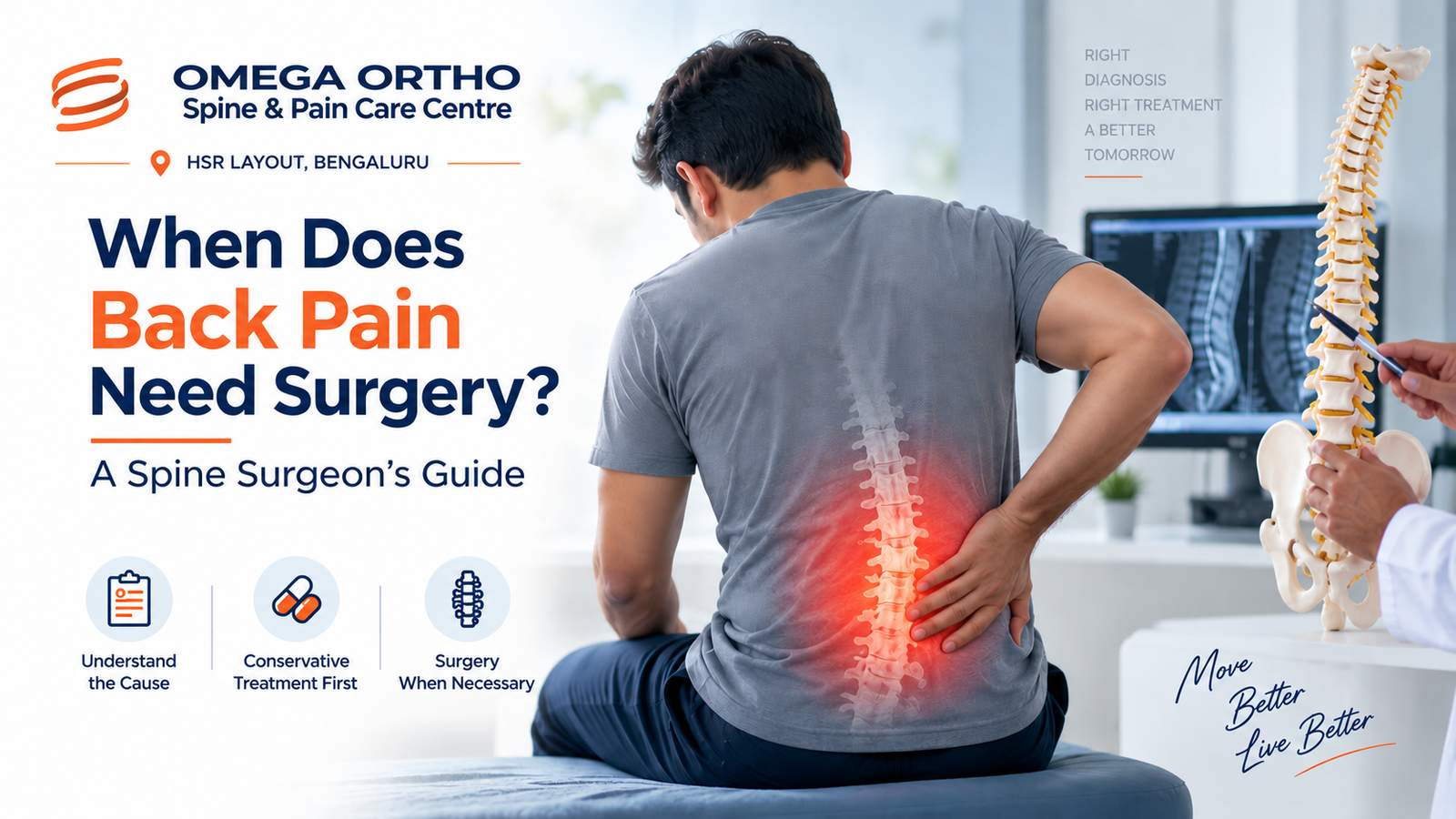
Back pain is one of the most common problems I see in my practice.
Some patients come to me after a few days of pain and are worried that they have damaged their spine. Others have been living with back pain for months or years and arrive with an MRI report that shows a “disc bulge”, “degeneration” or “stenosis”. Their first question is often the same:
“Doctor, do I need surgery?”
In most cases, the answer is not immediately.
Back pain has many possible causes, and most episodes of low back pain do not require surgery. The World Health Organization notes that non-specific low back pain accounts for the majority of cases and that rehabilitation and non-surgical care play an important role in recovery.
My approach is straightforward:
Conservative First. Surgery When Necessary.
Surgery has an important role in treating certain spinal conditions. But it should be recommended when there is a clear reason for it, not simply because an MRI shows an abnormality.
The more important question is not “Does my MRI look bad?”
It is:
“Does my clinical condition require surgery?”
Does Every Back Pain Problem Need Surgery?
No.
This is probably the most important message I want patients with back pain to understand.
The spine naturally undergoes changes with age. Disc dehydration, disc bulges, arthritis and other degenerative findings can appear on scans even in people who do not have significant symptoms.
At the same time, a patient can have severe symptoms despite relatively modest findings on an MRI.
That is why I do not make a surgical decision based on an MRI report alone.
A proper assessment considers:
- Your symptoms
- Duration of pain
- Location of pain
- Whether pain travels into the leg
- Numbness or tingling
- Muscle weakness
- Walking ability
- Physical examination
- Previous treatment
- MRI or other imaging when appropriate
- Your overall health
- How the condition is affecting your daily life
NICE guidance similarly recommends that imaging for low back pain or sciatica should be considered in specialist settings when the result is likely to change management.
First, We Need to Understand What Is Causing Your Back Pain
There is no single condition called “back pain.”
Pain can arise from different structures and conditions.
Some common causes include:
Muscle and soft-tissue problems
A strain or overload of the muscles and supporting tissues can cause acute lower back pain.
Disc-related problems
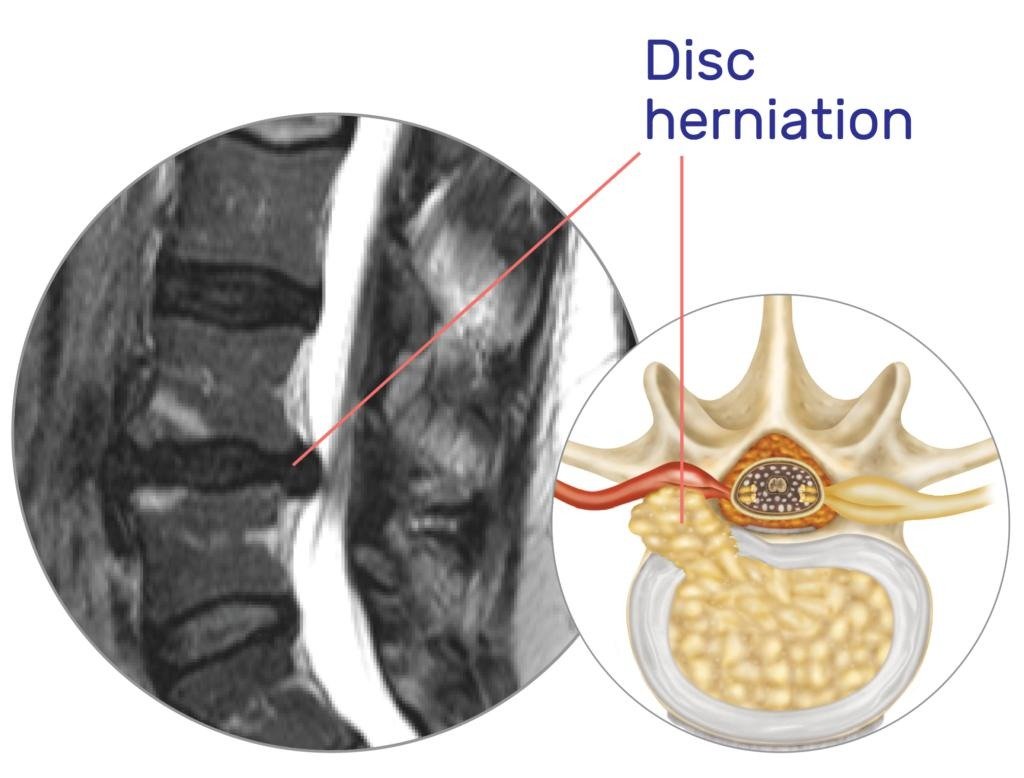
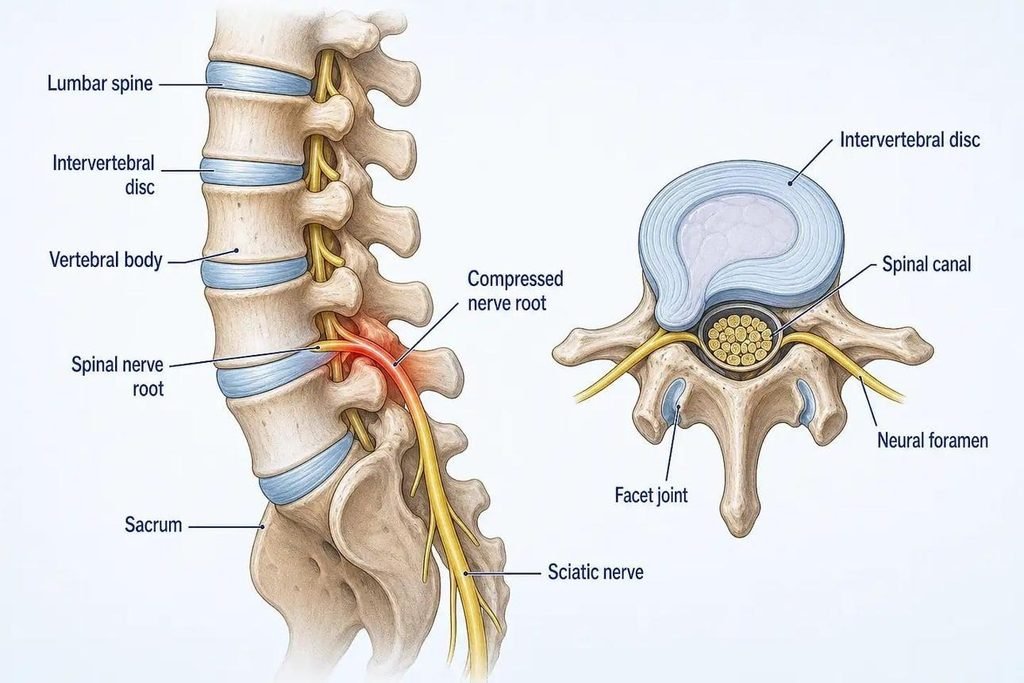
A disc can bulge or herniate and, in some patients, irritate or compress a nearby spinal nerve.
Sciatica
Nerve irritation can cause pain travelling from the lower back or buttock into the leg.
Spinal stenosis
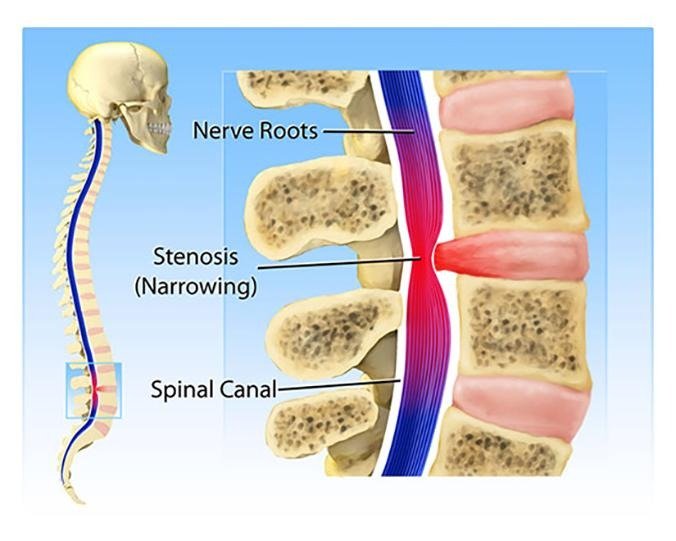
Narrowing around the spinal canal or nerve passages can cause leg pain, numbness or heaviness, particularly during standing and walking.
Spondylolisthesis
One vertebra may shift relative to another, potentially causing back pain or nerve compression.
Degenerative spinal conditions
Age-related changes involving discs and joints can sometimes produce pain or nerve-related symptoms.
Less common but important conditions
Infections, fractures, inflammatory disorders and certain cancers can also cause back pain. These require a different approach and should be considered when warning signs are present. NICE recommends considering alternative diagnoses when patients develop new or changed symptoms.
When Is Conservative Treatment Usually Appropriate?
For many patients, the first step is non-surgical treatment.
This does not mean ignoring the problem.
It means treating it without an operation when there is a reasonable chance of improvement without surgery.
Depending on the diagnosis, conservative treatment may include:
- Education about the condition
- Appropriate activity modification
- Physiotherapy
- Exercise-based rehabilitation
- Core and muscle strengthening
- Weight management where appropriate
- Workplace and ergonomic modifications
- Medicines when medically appropriate
- Follow-up assessment
WHO recommends a person-centred approach to chronic primary low back pain that can include education, exercise and other physical interventions, with treatment tailored to the individual’s circumstances.
One important point
Conservative treatment does not mean prolonged bed rest.
For many uncomplicated back pain conditions, remaining appropriately active and gradually returning to normal activities is an important part of recovery. NICE specifically recommends advice and support for self-management and continuation of normal activities.
What If Medicines and Physiotherapy Are Not Enough?
Not every patient improves with the first treatment plan.
That does not automatically mean that surgery is the next step.
Depending on the diagnosis, a spine specialist may consider other options.
These can include:
- Targeted pain management
- Nerve root blocks
- Epidural injections for selected cases of severe sciatica
- Facet-related procedures in appropriately selected patients
- Medial branch blocks
- Radiofrequency procedures for selected chronic facet-mediated pain
- Further rehabilitation
- Specialist review
These treatments are not suitable for every type of back pain.
For example, NICE recommends considering epidural injections of local anaesthetic and steroid for selected patients with acute and severe sciatica, while spinal injections are not recommended simply for managing non-specific low back pain.
This is why the diagnosis matters before deciding on any injection or procedure.
When Should You Consider Seeing a Spine Surgeon?
Seeing a spine surgeon does not mean you are going to have surgery.
In fact, a specialist consultation can help determine whether surgery is necessary or whether you can safely continue with non-surgical treatment.
You should consider a spine specialist in HSR Layout or another appropriate specialist if:
- Back pain keeps returning
- Pain has persisted despite appropriate treatment
- Pain is significantly affecting your work
- Pain is disturbing your sleep
- You have pain travelling into your leg
- You have numbness or tingling
- You notice weakness in the leg or foot
- Walking has become difficult
- You have recurrent episodes of sciatica
- Your symptoms are progressively worsening
- Your doctor suspects nerve compression or spinal stenosis
A spine consultation is particularly important when neurological symptoms are present.
What Symptoms May Make Surgery More Likely?
There are several situations in which a surgical opinion becomes more important.
1. Progressive Weakness
If a spinal nerve is significantly compressed, it can sometimes affect muscle strength.
For example, a patient may notice:
- Difficulty lifting the foot
- Foot dragging while walking
- Difficulty standing on the toes
- Difficulty standing on the heel
- Increasing weakness in the leg
Progressive neurological weakness requires timely medical assessment.
The decision about surgery depends on the underlying cause and severity.
2. Persistent Severe Sciatica
A herniated disc can compress a nerve and produce severe leg pain.
Many patients with sciatica improve without surgery. However, if severe symptoms continue despite appropriate non-surgical treatment and imaging demonstrates a problem that corresponds with the clinical symptoms, surgical decompression may become an appropriate option.
NICE recommends considering spinal decompression for people with sciatica when non-surgical treatment has not improved pain or function and radiological findings are consistent with the symptoms.
This is one of the clearest examples of why symptoms and imaging must match.
3. Significant Nerve Compression
Sometimes a disc herniation, spinal stenosis or another structural problem creates significant pressure around a nerve.
If the compression is causing persistent disabling symptoms or neurological problems, a spine surgeon may recommend decompression.
The goal is not simply to “fix the MRI.”
The goal is to relieve the structural problem that is causing the patient’s symptoms.
4. Spinal Stenosis With Significant Leg Symptoms
Spinal stenosis can narrow the space available for nerves.
Patients may experience:
- Leg pain while standing
- Leg pain while walking
- Numbness
- Heaviness in the legs
- Reduced walking distance
- Relief after sitting or bending forward
If these symptoms become significantly limiting and do not improve with appropriate non-surgical treatment, surgical decompression may be considered in selected patients.
5. Structural Instability or Other Specific Spinal Problems
Some patients have structural conditions where surgery may be considered because the underlying problem cannot reasonably be managed with conservative care alone.
Examples can include selected cases of:
- Spondylolisthesis
- Severe spinal deformity
- Certain fractures
- Significant structural instability
- Complex or recurrent spinal conditions
The type of operation depends entirely on the diagnosis.
6. Emergency Nerve Compression
There are certain symptoms where you should not wait for routine treatment.
Seek urgent medical attention if you develop:
- New loss of bladder control
- New loss of bowel control
- Difficulty passing urine
- Numbness around the groin or saddle area
- Severe or rapidly worsening weakness in the legs
- Significant neurological deterioration
These symptoms may indicate serious compression of the nerves in the lower spine and require urgent assessment.
Does the Size of a Disc Prolapse Decide Whether You Need Surgery?
Not by itself.
This is a common misconception.
A patient may have a large disc protrusion and relatively mild symptoms.
Another patient may have a smaller disc herniation that is positioned in a way that significantly irritates a nerve and causes severe leg pain.
Therefore, the size of a disc problem is only one part of the assessment.
I look at:
Symptoms + clinical examination + imaging + functional impact + response to treatment.
That combination provides a much better basis for deciding whether surgery is appropriate.
What If My MRI Says “Severe Disc Degeneration”?
Do not panic.
MRI reports often contain terms such as:
- Disc dehydration
- Disc bulge
- Disc degeneration
- Facet arthropathy
- Disc space narrowing
- Osteophytes
- Canal stenosis
These findings need to be interpreted in context.
Degenerative changes are common as people get older. The presence of an abnormality on an MRI does not automatically mean that it is the source of your pain.
This is another reason why I recommend discussing your scan with a qualified spine specialist rather than trying to interpret the report independently.
Do You Need an MRI Before Seeing a Spine Surgeon?
Not necessarily.
Many patients assume they need to get an MRI before consulting a spine specialist.
That is not always the case.
A specialist can first assess your symptoms and perform an examination and then decide whether imaging is necessary.
NICE recommends against routine imaging for low back pain with or without sciatica in non-specialist settings and recommends specialist imaging when the result is likely to change management.
If you already have an MRI, bring the actual images or digital scan along with the report if possible.
Do not bring only the written report.
The images themselves can be important when correlating the findings with your symptoms.
How Do I Decide Whether a Patient Needs Surgery?
There is no single test that answers this question.
I usually think through several important factors.
1. What is the actual diagnosis?
We need to understand what is causing the symptoms.
2. Are the symptoms severe?
Mild discomfort and disabling pain are not the same clinical situation.
3. How long have the symptoms been present?
The duration and progression of symptoms matter.
4. Is there nerve involvement?
Numbness, weakness and radiating leg pain may indicate nerve irritation or compression.
5. Has appropriate non-surgical treatment been tried?
For many conditions, conservative treatment should be given an appropriate opportunity to work.
6. Is the imaging consistent with the symptoms?
An abnormal MRI that does not match the patient’s symptoms should not automatically lead to surgery.
7. Is surgery likely to provide meaningful benefit?
This is perhaps the most important question.
Surgery should have a clear purpose.
What Does “Conservative First” Actually Mean?
When I say “Conservative First. Surgery When Necessary,” I do not mean that surgery is bad or should be avoided at all costs.
It means that treatment should be proportional to the problem.
If a patient has uncomplicated back pain and is likely to improve with exercise, rehabilitation and appropriate non-surgical care, there is usually no reason to rush into surgery.
But if a patient has significant nerve compression with progressive weakness, or persistent disabling sciatica with a structural problem that corresponds to the symptoms, delaying a necessary surgical assessment may not be appropriate.
The goal is neither to operate too early nor to delay surgery when it is genuinely needed.
That balance is important.
What Types of Spine Surgery May Be Considered?
If surgery is indicated, the procedure depends on the underlying condition.
Discectomy
A discectomy removes the portion of a herniated disc that is compressing a nerve.
It may be considered in selected patients with symptomatic disc herniation and persistent nerve-related symptoms.
Decompression Surgery
Decompression creates more space for compressed nerves.
It may be considered for selected patients with conditions such as spinal stenosis or nerve compression.
Endoscopic Spine Surgery
Endoscopic techniques use a small working corridor and specialised camera systems to access selected spinal problems.
They may be appropriate for certain disc and nerve compression conditions.
Minimally Invasive Spine Surgery
Minimally invasive approaches aim to achieve the required surgical objective while limiting unnecessary disruption to surrounding tissues when clinically appropriate.
Spinal Fusion
Fusion may be considered for selected structural problems where stabilisation of the spine is part of the surgical objective.
It is not a routine treatment for ordinary non-specific low back pain.
NICE specifically advises against spinal fusion for low back pain outside a randomised controlled trial in its current NG59 recommendation set.
This again highlights an important principle:
The type of surgery must match the diagnosis.
Is Minimally Invasive Spine Surgery Always Better?
Not necessarily.
Patients understandably prefer smaller incisions and faster recovery whenever possible.
However, the smallest incision is not automatically the best operation.
The correct procedure depends on:
- The spinal level involved
- The underlying diagnosis
- Nerve compression
- Spinal stability
- Previous surgery
- Patient health
- Surgical objective
If an endoscopic or minimally invasive procedure can safely achieve the required result, it may be considered.
But I would never recommend a particular surgical technique simply because it sounds more advanced.
The right surgery for the right patient is more important than the name of the technique.
How Long Should You Try Non-Surgical Treatment Before Considering Surgery?
There is no universal number of days or weeks that applies to every patient.
The answer depends on the condition.
For uncomplicated back pain, symptoms may improve over time with appropriate management.
For sciatica caused by nerve compression, the natural course can also be favourable in many patients.
But if a patient develops progressive weakness, significant neurological symptoms or other warning signs, waiting simply to complete an arbitrary number of weeks may not be appropriate.
Similarly, if severe symptoms persist despite appropriate treatment and there is a clear structural cause that matches the symptoms, a surgical consultation may be reasonable.
The timeline should be based on the clinical situation, not a fixed calendar.
Can Back Pain Come Back After Surgery?
Yes.
Spine surgery can successfully address a specific structural problem, but it does not make the entire spine immune to future problems.
A patient can develop:
- Recurrent disc problems
- Degenerative changes at another level
- Muscle-related back pain
- New spinal problems
- Adjacent segment problems in selected situations
This is why surgery should be considered one part of treatment, not the end of the patient’s responsibility for spine health.
Maintaining appropriate physical activity, strength, healthy body weight and good lifestyle habits remains important.
What Can You Do to Protect Your Spine?
You do not need to live in fear of your spine.
Simple habits can help maintain physical function.
Stay physically active
Regular movement is important.
Build strength
Appropriate strengthening of the trunk, hips and lower limbs can support overall physical function.
Avoid prolonged inactivity
Long periods of sitting without movement can contribute to discomfort.
Maintain a healthy weight
A healthy body weight reduces overall physical stress on the musculoskeletal system.
Stop smoking
Smoking is associated with poorer musculoskeletal and spinal health.
Sleep well
Good sleep is important for overall recovery and pain management.
Return to activity gradually after an injury
Do not go from complete inactivity directly to intense exercise or heavy lifting.
WHO identifies physical activity, healthy body weight, not smoking, good sleep and ergonomic adjustments among measures that can support people with low back pain.
Back Pain and Long Working Hours in Bengaluru
In Bengaluru, particularly around HSR Layout, Koramangala, BTM Layout, Harlur, Agara, Sarjapur Road, Bellandur, Bommanahalli and Kudlu, many people spend long hours sitting at computers or commuting.
This does not mean that sitting is automatically damaging your spine.
The bigger concern is often a combination of:
- Long periods without movement
- Low physical activity
- Poor conditioning
- Repetitive physical work
- Inadequate recovery
- Existing spinal conditions
If your back pain repeatedly interferes with work, exercise, sleep or everyday activities, it is worth getting an appropriate assessment.
When Should You Not Wait?
There are situations where back pain should not simply be treated as an ordinary muscular problem.
Seek urgent medical attention if you have:
New bladder or bowel problems
Numbness around the groin or saddle area
Severe or progressive weakness
Major neurological deterioration
Severe back pain following significant trauma
Other concerning symptoms, such as unexplained weight loss, fever, history of cancer or other systemic symptoms, also warrant appropriate medical evaluation.
Serious causes of low back pain are uncommon, but clinicians are advised to screen for red flags and consider alternative diagnoses when symptoms change.
The Question Is Not “Surgery or No Surgery?”
I often explain this to patients in a slightly different way.
The decision is not simply:
Surgery vs. no surgery.
There is a treatment pathway.
It may look something like this:
Assessment
↓
Correct diagnosis
↓
Conservative treatment where appropriate
↓
Rehabilitation and follow-up
↓
Further evaluation if symptoms persist
↓
Selected injections or procedures when clinically appropriate
↓
Surgical evaluation when there is a clear indication
↓
Appropriate spine surgery when the expected benefit outweighs the risks
This is the principle behind Conservative First. Surgery When Necessary.
Spine Surgeon in HSR Layout, Bengaluru
If you are looking for a spine surgeon in HSR Layout, Bengaluru, or a spine specialist near HSR Layout for persistent back pain, sciatica, slipped disc, nerve compression or spinal stenosis, the first step should be an appropriate clinical assessment.
At Omega Ortho Spine & Pain Care Centre, the focus is on understanding the cause of the patient’s symptoms and selecting an appropriate treatment pathway.
Treatment may include conservative care, rehabilitation, selected interventional pain procedures and, when clinically indicated, minimally invasive or advanced spine surgery.
The objective is not to perform surgery simply because a scan shows a problem.
The objective is to identify the problem that is actually causing the patient’s symptoms and recommend the treatment that is most appropriate for that individual.
Meet Dr. Kiran Tej Daggupati
Dr. Kiran Tej Daggupati
Orthopaedic & Spine Surgeon
Minimally Invasive Spine Specialist
Omega Ortho Spine & Pain Care Centre
504, 22nd Cross Road, HSR Layout, Bengaluru, Karnataka 560102
Appointments: 097435 47999
Dr. Kiran Tej Daggupati evaluates and treats a range of orthopaedic and spine conditions, with an emphasis on appropriate conservative care and minimally invasive treatment when clinically suitable.
For patients who require surgery, the treatment plan is based on the diagnosis, symptoms, neurological findings, imaging and overall clinical situation.
Frequently Asked Questions About Back Pain and Surgery
Does back pain always require surgery?
No. Most cases of non-specific low back pain are managed without surgery. Conservative treatment, rehabilitation and appropriate lifestyle measures play an important role in management.
How do I know if my back pain is serious?
Persistent or worsening pain, pain travelling into the leg, numbness, tingling, weakness or difficulty walking should be medically assessed. New bladder or bowel problems, saddle-area numbness or significant progressive weakness require urgent attention.
Does a slipped disc mean I need surgery?
No. Many patients with a slipped or herniated disc improve without surgery. Surgery may be considered when symptoms persist despite appropriate treatment, neurological problems develop, or there is significant nerve compression that corresponds with the patient’s symptoms.
Can sciatica be treated without surgery?
Yes. Many patients with sciatica improve with non-surgical treatment. In selected cases, injections may be considered. Surgery may be considered when significant symptoms persist despite appropriate treatment and imaging findings correspond with the clinical picture.
Does an MRI decide whether I need surgery?
No. An MRI is an important diagnostic tool, but it should be interpreted together with your symptoms and physical examination. NICE recommends specialist imaging when the result is likely to change management.
When should I see a spine surgeon?
You can consult a spine surgeon if your back pain is persistent, recurrent, significantly affecting your daily activities, associated with leg symptoms or not improving with appropriate treatment. Seeing a spine surgeon does not automatically mean that surgery will be recommended.
Is endoscopic spine surgery suitable for everyone?
No. Endoscopic spine surgery is appropriate for selected spinal conditions. The suitability depends on the exact diagnosis, location of the problem, nerve compression, spinal stability and other individual factors.
Are injections an alternative to surgery?
In selected patients, certain injections may help manage symptoms or form part of the treatment pathway. They are not appropriate for every type of back pain and should be recommended based on the diagnosis. NICE recommends epidural injections for selected patients with acute and severe sciatica, but does not recommend spinal injections for managing non-specific low back pain.
Can I avoid spine surgery permanently?
There is no way to guarantee that. Many people never require spine surgery, particularly when appropriate preventive and conservative care is followed. However, certain conditions can eventually require surgery. The important thing is to identify when surgery is actually beneficial rather than avoiding it at all costs.
Final Word From the Spine Surgeon
Back pain can be frightening, particularly when an MRI report contains words such as “disc prolapse”, “stenosis” or “degeneration.”
But an abnormal MRI does not automatically mean you need an operation.
At the same time, persistent nerve compression or progressive neurological symptoms should not be ignored simply because you want to avoid surgery.
Good spine care is about finding the right balance.
Treat conservatively when it is safe and appropriate.
Use targeted procedures when they have a clear role.
Consider surgery when there is a genuine surgical indication.
And when surgery is required, choose the procedure based on the patient’s condition rather than simply choosing the most fashionable technique.
Conservative First. Surgery When Necessary.
That is the principle I believe should guide every decision about spine surgery.
Medical Disclaimer
This article is for general educational purposes and does not replace an individual medical consultation. Back pain can have many different causes, and treatment should be based on a patient’s symptoms, medical history, physical examination and appropriate investigations. The information above should not be used to diagnose or treat yourself. If you develop new bladder or bowel problems, numbness around the groin or saddle area, or severe or progressive weakness, seek urgent medical attention.