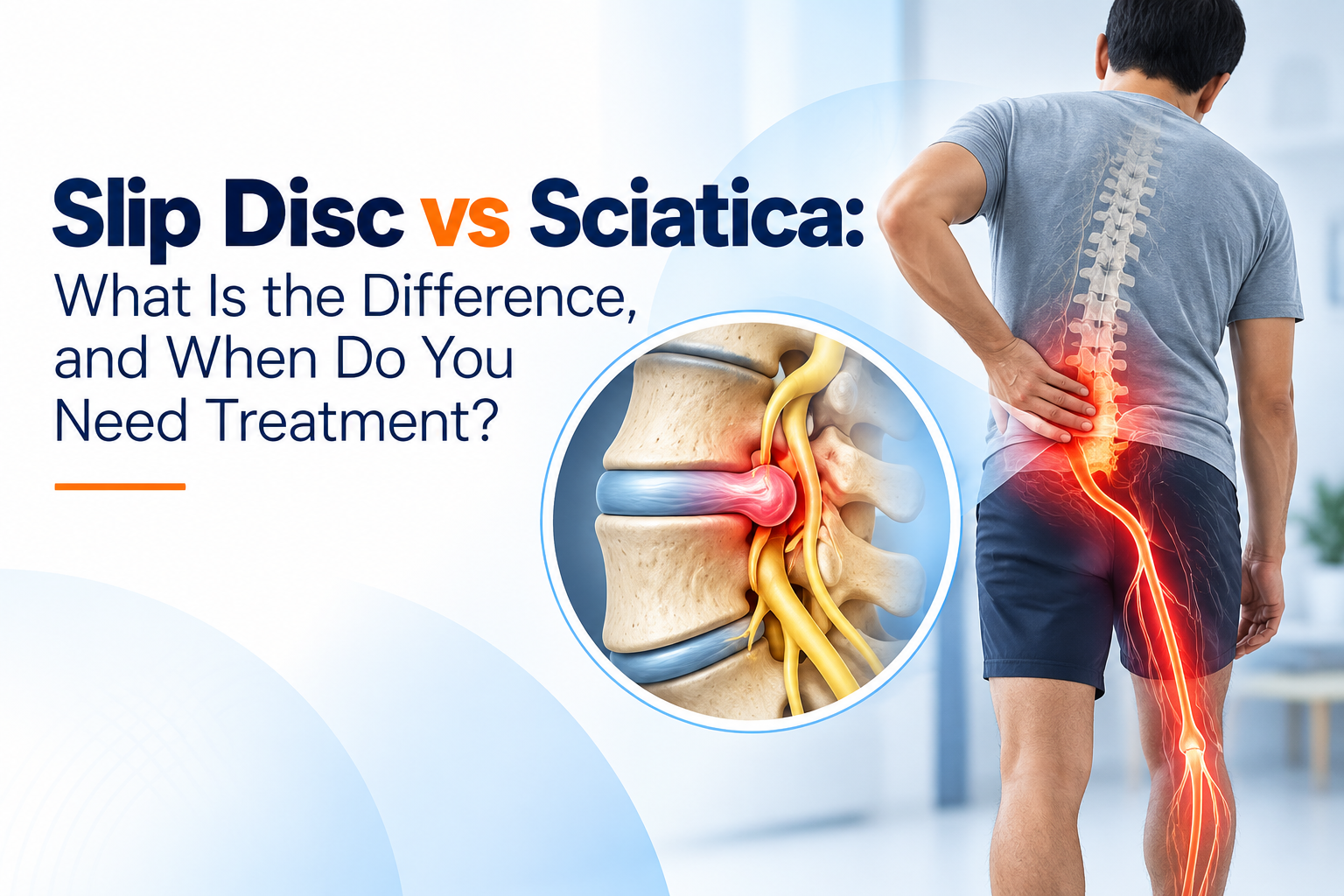
Doctor, I have a slip disc. Does that mean I have sciatica?
My MRI says I have a disc bulge. Is that why my leg is hurting?
I have severe pain going down my leg. Do I need surgery?
These are some of the most common questions patients ask when they experience back pain with leg symptoms.
The confusion is understandable because slip disc and sciatica are often mentioned together, but they are not the same thing.
A slip disc, more accurately called a herniated disc, disc prolapse or disc herniation, describes a problem with one of the discs between the bones of the spine.
Sciatica describes a pattern of symptoms caused by irritation or compression of a spinal nerve root that contributes to the sciatic nerve.
A herniated disc can cause sciatica, but not every slip disc causes sciatica.
Similarly, you can have sciatica without a slip disc. Other conditions such as spinal stenosis, spondylolisthesis and degenerative changes can also irritate spinal nerves.
This distinction matters because treatment should not be decided simply by looking at an MRI report.
The more important question is:
What is causing your symptoms, and how significantly is it affecting your function and quality of life?
Slip Disc vs Sciatica: The Difference in Simple Terms
The easiest way to understand it is:
Slip Disc = A Structural Problem
A slip disc is a problem involving an intervertebral disc.
The disc may bulge, protrude or herniate and, in some patients, may irritate or compress a nearby nerve.
Sciatica = A Pattern of Symptoms
Sciatica refers to symptoms caused by irritation or compression of the nerves contributing to the sciatic nerve.
It commonly causes pain travelling from the lower back or buttock into the leg.
So:
Slip disc → may compress a nerve → may cause sciatica
But:
Slip disc ≠ automatically sciatica
And:
Sciatica ≠ automatically slip disc
This is one of the most important concepts for patients to understand.
What Exactly Is a Slip Disc?
Your spine is made up of individual bones called vertebrae.
Between many of these vertebrae are intervertebral discs. These discs act as cushions and help the spine absorb loads while allowing movement.
Each disc has:
- A tougher outer layer
- A softer inner portion
Sometimes the outer portion develops weakness or a tear and part of the inner material pushes outward.
Patients commonly call this a slip disc.
However, the disc does not literally “slip” out of position. Medical terms you may hear include:
- Herniated disc
- Disc herniation
- Prolapsed disc
- Disc protrusion
- Disc extrusion
A disc problem can occur in the lower back or neck, although lumbar disc problems are particularly relevant when patients develop leg symptoms.
What Is Sciatica?
Sciatica refers to pain or other nerve-related symptoms along the pathway of the sciatic nerve.
The sciatic nerve is formed by nerve roots coming from the lower spine and travels through the buttock and down the leg.
When one of these nerve roots becomes irritated or compressed, you may experience:
- Pain travelling down the leg
- Burning pain
- Electric-shock-like pain
- Tingling
- Pins and needles
- Numbness
- Weakness
For some patients, the leg pain is more troublesome than the back pain.
A typical pattern may look like:
Lower back → Buttock → Thigh → Calf → Foot
The exact distribution depends on which nerve root is affected.
Can a Slip Disc Cause Sciatica?
Yes.
A herniated disc is one of the common causes of sciatica.
Imagine a disc protruding towards a nerve root.
If that disc irritates or compresses the nerve, the patient may develop pain, tingling, numbness or weakness travelling into the leg.
But there is an important distinction.
Patient A
MRI shows a disc bulge.
They have no leg pain, no numbness and no weakness.
Patient B
MRI shows a similar disc bulge.
They have severe pain travelling down one leg, numbness and weakness that correspond with the affected nerve.
The MRI may look similar.
The clinical situation is completely different.
This is why an MRI report should not be treated as a diagnosis by itself.
The scan needs to be interpreted together with your symptoms and examination.
Can You Have a Slip Disc Without Sciatica?
Yes.
A disc problem does not always compress or irritate a nerve.
Some patients may have:
- Localised lower back pain
- Back stiffness
- Pain with certain movements
Others may have a disc abnormality on MRI without significant symptoms at all.
In fact, disc changes can sometimes be seen on imaging in people who do not have significant pain.
Therefore:
Disc bulge on MRI does not automatically mean the disc is causing your pain.
This is particularly important when patients undergo MRI scans and become worried after reading terms such as “disc degeneration”, “disc bulge” or “disc protrusion.”
Can You Have Sciatica Without a Slip Disc?
Yes.
Sciatica can occur because of several different conditions.
These may include:
1. Herniated or slipped disc
A disc can irritate a nearby nerve root.
2. Spinal stenosis
The spaces through which nerves travel can become narrower.
3. Spondylolisthesis
One vertebra can shift relative to another and contribute to nerve compression.
4. Degenerative changes
Age-related changes in the spine can sometimes reduce the space available for nerves.
5. Certain spinal injuries
Trauma can sometimes cause conditions that affect spinal nerves.
Therefore, if pain is travelling down your leg, the goal is not simply to label it “sciatica.”
The important question is:
Why is the nerve being irritated?
Slip Disc Symptoms: What Should You Look For?
A slip disc does not always cause symptoms.
When symptoms occur, they depend on the location of the disc problem and whether a nerve is involved.
Possible symptoms include:
Lower back pain
Pain around the lower back may become worse with certain movements.
Buttock pain
Some patients experience pain around one or both buttocks.
Leg pain
If a nerve is affected, pain may travel down the leg.
Tingling
Patients may describe pins and needles or an abnormal sensation.
Numbness
Reduced sensation may occur in part of the leg or foot.
Weakness
Significant nerve compression can sometimes cause weakness.
Difficulty moving
Severe pain can make bending, walking or changing positions difficult.
Sciatica Symptoms: How Does It Usually Feel?
Sciatica tends to have a more specific pattern than ordinary lower back pain.
You may experience:
- Pain in the buttock
- Pain behind the thigh
- Pain extending towards the calf
- Pain reaching the foot or toes
- Burning sensation
- Electric or shooting pain
- Tingling
- Numbness
- Weakness
One useful clue is pain travelling down the leg.
If you have only localised Lower Back Pain without leg symptoms, it may not be sciatica.
However, symptoms can vary between patients, so a proper assessment is important.
Why Does a Slip Disc Happen?
There is usually not one single cause.
Several factors can contribute.
Age-related disc changes
As we age, discs can gradually lose some of their water content and flexibility.
This can make them more vulnerable to injury.
Heavy lifting
Lifting heavy objects, particularly with poor technique or while twisting, can increase stress on the spine.
Repetitive physical activity
Repeated bending, lifting or twisting can place additional mechanical stress on the back.
Prolonged sitting
Long periods of sitting or driving may contribute to back discomfort, particularly when combined with low physical activity.
Physical inactivity
Poor conditioning can affect how the body handles everyday physical demands.
Smoking
Smoking is associated with poorer disc health.
Previous back problems
Patients who have previously experienced disc-related symptoms may have recurrent episodes.
However, it is important not to blame one particular activity for every disc problem.
Disc conditions can develop through a combination of age, genetics, physical demands, conditioning and other individual factors.
What Causes Sciatica?
Sciatica occurs when a nerve is irritated or compressed.
A slipped or herniated disc is a common cause, but other causes include:
- Spinal stenosis
- Spondylolisthesis
- Degenerative spinal changes
- Certain spinal injuries
- Other less common spinal conditions
Therefore, treatment should target the underlying cause, rather than treating the word “sciatica” alone.
Does Every Slip Disc Need Surgery?
No.
This is probably one of the most important things patients should understand.
A diagnosis of a slipped disc does not automatically mean surgery.
Many patients improve with appropriate non-surgical treatment, rehabilitation and time. Depending on the individual situation, treatment may include:
- Education about the condition
- Activity modification
- Physiotherapy
- Exercise-based rehabilitation
- Appropriate medication
- Lifestyle modification
- Observation and follow-up
- Selected pain procedures
The treatment pathway depends on:
Symptoms + Examination + Imaging + Neurological findings + Response to treatment
Can a Slip Disc Heal Without Surgery?
Yes, in many patients.
This does not necessarily mean that the disc instantly returns to its original appearance.
What matters clinically is whether the patient’s symptoms improve and function returns.
Many patients with uncomplicated disc-related symptoms improve with:
- Appropriate activity
- Rehabilitation
- Physiotherapy
- Medication when medically appropriate
- Lifestyle changes
- Time
Some herniated disc material can also reduce in size over time.
Therefore, finding a slip disc on an MRI does not mean you should immediately start looking for surgery.
Can Sciatica Get Better Without Surgery?
Yes.
Many cases of sciatica improve over weeks to months.
Treatment may involve:
- Staying appropriately active
- Physiotherapy
- Exercise
- Pain management
- Activity modification
- Lifestyle changes
- Selected injections where appropriate
The exact pathway depends on what is causing the nerve irritation.
Sciatica caused by a small disc herniation may be managed differently from sciatica caused by significant spinal stenosis.
Should You Rest Completely If You Have Sciatica?
Usually, prolonged bed rest is not the answer.
During a painful flare-up, you may need to temporarily reduce activities that clearly worsen your symptoms.
But complete inactivity for an extended period can make it harder to regain strength and function.
The general approach is:
Reduce aggravating activity → control symptoms → gradually restore movement → strengthen → return to normal activities
Gentle activity such as walking may be appropriate for many patients, depending on their symptoms and underlying condition.
What Should You Avoid During a Sciatica Flare-Up?
There is no universal list of movements that every patient must avoid.
However, during an acute episode, it is sensible to avoid activities that clearly increase symptoms.
These may include:
- Sudden heavy lifting
- Repeated bending and twisting when painful
- High-impact exercise during a severe flare-up
- Prolonged bed rest
- Returning to heavy exercise too quickly
The objective is not to become afraid of movement.
The objective is to move appropriately while the irritated nerve or spine recovers.
Do You Need an MRI for a Slip Disc or Sciatica?
Not always.
This is another area where patients can easily become confused.
MRI is very useful for looking at:
- Discs
- Nerves
- Spinal canal
- Other soft tissues
But an MRI is not automatically necessary for every person with back pain or sciatica.
It becomes more useful when:
- Symptoms persist
- Neurological symptoms are present
- Weakness is developing
- A specific spinal condition is suspected
- The result could change treatment
- Surgery or another intervention is being considered
An MRI finding also needs to correspond with the patient’s symptoms and examination.
Do not treat the MRI report instead of treating the patient.
What Happens During a Slip Disc or Sciatica Consultation?
A proper consultation should involve much more than simply looking at the MRI.
Your doctor may ask:
Where did the pain begin?
Was it initially in the back, buttock or leg?
Does the pain travel?
Does it stay in your back or travel down the leg?
Which side is affected?
Right, left or both?
Do you have numbness or tingling?
These symptoms can help identify whether a nerve may be involved.
Do you have weakness?
Weakness can be more clinically important than pain alone.
How long have you had the symptoms?
Duration and progression matter.
What makes it worse?
Sitting, walking, bending, lifting, coughing or other activities?
What treatment have you already tried?
Medication, physiotherapy, injections or other treatment?
A physical and neurological examination can then help determine whether the symptoms are consistent with nerve irritation or another condition.
Treatment Options for Slip Disc and Sciatica
Treatment should be individualised.
There is no single treatment that is appropriate for every patient.
1. Conservative Treatment
For many patients, treatment begins without surgery.
This may include:
- Education
- Activity modification
- Appropriate exercise
- Physiotherapy
- Rehabilitation
- Medication when appropriate
- Lifestyle modification
The goal is not merely to reduce pain temporarily.
It is to help the patient gradually return to normal function.
2. Physiotherapy and Rehabilitation
Physiotherapy may play an important role in recovery.
Depending on the diagnosis, rehabilitation may focus on:
- Improving mobility
- Building strength
- Core conditioning
- Hip and lower-limb function
- Movement patterns
- Gradual return to activity
- Work-related modifications
- Safe return to sports
The programme should be based on the patient’s symptoms and clinical condition rather than a generic exercise list.
3. Pain Procedures and Injections
Some patients continue to experience significant symptoms despite conservative treatment.
In selected cases, targeted procedures may be considered.
Depending on the diagnosis, these may include:
- Nerve root blocks
- Epidural injections
- Facet joint injections
- Medial branch blocks
- Radiofrequency procedures
These are not routine treatments for every patient.
The decision should depend on the diagnosis, symptoms, examination and expected benefit.
4. Minimally Invasive Spine Treatment
If surgery is genuinely required, minimally invasive techniques may be appropriate for selected conditions.
Depending on the diagnosis, procedures may include:
- Minimally invasive discectomy
- Decompression surgery
- Endoscopic spine surgery
- Other condition-specific minimally invasive procedures
The purpose of minimally invasive surgery is to address the structural problem while limiting unnecessary disruption to surrounding tissues when the technique is appropriate.
But there is an important principle:
Minimally invasive does not mean surgery is automatically necessary.
The first question should always be:
Do I actually need surgery?
When Is Surgery Considered for a Slip Disc?
Most patients with a slipped disc do not require surgery.
Surgery may be considered when:
- Severe symptoms persist despite appropriate non-surgical treatment
- There is significant nerve compression
- Progressive neurological weakness develops
- Symptoms substantially affect quality of life
- Clinical findings and imaging clearly correspond
- There is an urgent neurological problem
The exact operation depends on the underlying problem.
A focal disc herniation compressing a nerve may require a different procedure from spinal stenosis or spinal instability.
Does Sciatica Always Need Surgery?
No.
Surgery is not the default treatment for sciatica.
A surgical discussion may become appropriate when:
- Pain remains severe and disabling
- Appropriate non-surgical treatment has not provided adequate improvement
- There is significant or progressive neurological weakness
- There is persistent nerve compression
- Imaging findings match the clinical symptoms
- An urgent neurological problem is present
The objective is not simply to “operate on sciatica.”
The objective is to identify and treat the structural cause of the nerve compression when surgery is appropriate.
What Is Endoscopic Slip Disc Surgery?
Endoscopic spine surgery uses a small working channel and specialised instruments to access selected spinal problems.
For appropriately selected patients, endoscopic techniques may be used to treat certain disc-related nerve compression problems.
However, endoscopic surgery is not suitable for every patient.
Suitability depends on factors such as:
- Location of the disc problem
- Type of disc herniation
- Degree and location of nerve compression
- Spinal stability
- Previous spine surgery
- Overall health
- Symptoms
- Neurological findings
Therefore, choosing the newest or smallest-looking procedure is not necessarily the goal.
The right procedure for the right diagnosis is more important.
Is Endoscopic Spine Surgery Better Than Conventional Surgery?
There is no universal answer.
Endoscopic or minimally invasive surgery can be beneficial for selected patients, but not every spinal condition is suitable for an endoscopic approach.
The decision should consider:
- Your diagnosis
- Anatomy
- Location of compression
- Surgical objective
- Spinal stability
- Previous surgeries
- Overall health
A smaller incision does not automatically mean a better operation.
The goal is to choose the safest and most appropriate procedure for the individual patient.
How Long Does Sciatica Take to Improve?
There is no single timeline that applies to everyone.
Many uncomplicated cases improve over several weeks to months, but some symptoms can persist longer.
Recovery depends on:
- Cause of sciatica
- Severity of nerve irritation
- Presence of weakness or numbness
- Duration of symptoms
- General health
- Response to treatment
- Rehabilitation
If symptoms are progressively worsening or significantly affecting your ability to walk, work or sleep, do not simply wait indefinitely.
Can You Work With a Slip Disc or Sciatica?
In many cases, yes, but the answer depends on the severity of symptoms and the nature of your work.
For Bengaluru’s IT professionals, long periods of sitting can become particularly uncomfortable when combined with low physical activity.
The goal should not necessarily be to stop working completely.
Instead, consider:
- Regular movement breaks
- Appropriate workstation setup
- Avoiding prolonged static positions
- Gradual activity
- Appropriate rehabilitation
- Following the advice of your treating doctor
If symptoms repeatedly interfere with work, sleep or daily activities, a proper evaluation is worthwhile.
When Should You See a Spine Specialist?
Consider a specialist evaluation if you have:
- Persistent back pain
- Leg pain that is not improving
- Recurrent sciatica
- Numbness
- Tingling
- Leg weakness
- Difficulty walking
- Pain affecting sleep
- Pain affecting work
- Repeated episodes despite treatment
- Symptoms following significant trauma
A consultation with a Spine Surgeon in HSR Layout does not automatically mean surgery will be recommended.
The purpose is to determine the cause of the symptoms and understand the appropriate treatment pathway.
Warning Signs: When Should You Seek Urgent Medical Attention?
Most back pain and sciatica are not emergencies.
However, certain symptoms require urgent assessment.
Seek immediate medical attention if you develop:
- New loss of bladder control
- New loss of bowel control
- Difficulty passing urine
- Numbness around the groin or saddle area
- Severe or rapidly worsening weakness
- Significant neurological deterioration
- Severe symptoms after major trauma
These symptoms can indicate serious nerve compression and should not be ignored.
A Practical Decision Path for Patients
If you are confused about what to do next, think of treatment as a pathway rather than simply “surgery vs no surgery.”
Step 1: Understand the symptoms
Where is the pain?
Does it travel?
Is there numbness or weakness?
Step 2: Get the right diagnosis
Your symptoms and physical examination are important.
Step 3: Use imaging when clinically appropriate
An MRI can provide important information, but it needs to be interpreted in context.
Step 4: Start appropriate non-surgical treatment
When safe and appropriate, this may include medication, activity modification, physiotherapy and rehabilitation.
Step 5: Reassess
If symptoms improve, continue the recovery pathway.
If they persist or worsen, further evaluation may be necessary.
Step 6: Consider targeted procedures when appropriate
Selected injections or other interventions may have a role for some patients.
Step 7: Consider surgery when there is a genuine indication
Surgery should be considered when the expected benefits outweigh the risks and the structural problem clearly corresponds with the patient’s symptoms.
This is the principle behind:
Conservative First. Surgery When Necessary.
Slip Disc and Sciatica Treatment in HSR Layout, Bengaluru
If you are searching for Slip Disc Treatment in HSR Layout, Bengaluru, Sciatica Treatment in HSR Layout, or a Spine Specialist in HSR Layout, the first step should be an accurate assessment of the underlying cause.
At Omega Ortho Spine & Pain Care Centre, HSR Layout, Bengaluru, Dr. Kiran Tej Daggupati evaluates patients with:
- Slip disc and herniated disc
- Sciatica
- Nerve compression
- Lower back pain
- Spinal stenosis
- Other spine-related conditions
Treatment may include conservative management, physiotherapy and rehabilitation, selected interventional pain procedures, or minimally invasive spine surgery when clinically indicated.
The objective is not simply to treat an MRI finding.
The objective is to understand what is causing your symptoms and choose the appropriate treatment for your condition.
Meet Dr. Kiran Tej Daggupati
Dr. Kiran Tej Daggupati
Orthopaedic & Spine Surgeon
Minimally Invasive Spine Specialist
Omega Ortho Spine & Pain Care Centre
504, 22nd Cross Road, HSR Layout, Bengaluru, Karnataka 560102
Appointments: 097435 47999
Dr. Kiran Tej Daggupati evaluates and treats spine and orthopaedic conditions, including back pain, disc-related problems, sciatica and nerve compression.
His treatment approach focuses on considering conservative treatment whenever appropriate and recommending procedures or surgery when there is a clear clinical indication.
Frequently Asked Questions
Is a slip disc and sciatica the same thing?
No. A slip disc is a structural problem involving a spinal disc. Sciatica describes a pattern of nerve-related symptoms, commonly pain travelling from the lower back or buttock into the leg.
Can a slip disc cause sciatica?
Yes. A herniated disc can irritate or compress a spinal nerve and cause sciatica. However, not every slip disc causes sciatica.
Can I have sciatica without a slip disc?
Yes. Sciatica can also result from spinal stenosis, spondylolisthesis, degenerative changes and certain spinal injuries.
Can a slipped disc heal without surgery?
Yes. Many patients improve with appropriate non-surgical treatment, rehabilitation and time. Surgery is reserved for selected situations.
Does every slip disc require surgery?
No. Surgery is generally considered when significant symptoms persist despite appropriate treatment, neurological problems develop or there is a structural problem that clearly requires surgical treatment.
Can sciatica get better without surgery?
Yes. Many cases improve over weeks to months with appropriate non-surgical management.
Do I need an MRI for sciatica?
Not necessarily. MRI is generally used when the clinical situation warrants imaging, particularly when symptoms persist, neurological problems are present or the result could change treatment.
Does an MRI showing a disc bulge mean I need surgery?
No. A disc bulge on an MRI does not automatically mean that it is causing your symptoms or that surgery is required.
Can I walk if I have sciatica?
In many uncomplicated cases, gentle activity and walking may be appropriate. However, activity should be guided by your symptoms and underlying condition.
Should I stay in bed if I have a slip disc?
Prolonged bed rest is generally not recommended. During severe symptoms, activity may need to be temporarily modified, followed by gradual movement and rehabilitation.
When should I see a spine specialist?
Consider an evaluation if symptoms persist, recur, affect your work or sleep, travel into the leg, or are associated with numbness, tingling or weakness.
Do injections cure a slip disc?
Not necessarily. Selected injections may help manage symptoms in appropriate patients, but they do not automatically correct the underlying structural problem.
When is surgery considered for sciatica?
Surgery may be considered when significant symptoms persist despite appropriate non-surgical treatment, there is progressive neurological weakness, or a structural problem causing nerve compression clearly corresponds with the clinical picture.
Is endoscopic spine surgery suitable for everyone?
No. Endoscopic surgery is suitable only for selected spinal conditions. The location and type of disc problem, nerve compression, spinal stability, previous surgery and other factors need to be assessed.
Is endoscopic surgery always better than conventional surgery?
No. The most appropriate surgical technique depends on the individual diagnosis and anatomy. The smallest incision is not automatically the best treatment.
Can a slip disc come back?
Yes. Symptoms can recur, and patients can also develop new disc or degenerative problems at the same or another spinal level. Long-term physical conditioning and appropriate spine care remain important.
Can I exercise with a slip disc?
Exercise may be an important part of recovery, but the appropriate type and intensity depend on your symptoms and diagnosis. A structured rehabilitation programme is preferable to suddenly returning to heavy exercise.
Can sitting for long hours cause a slip disc?
Long periods of sitting may contribute to back discomfort, particularly when combined with low physical activity. However, disc problems usually have multiple contributing factors rather than one single cause.
What are the emergency symptoms of a slipped disc?
New bladder or bowel problems, difficulty passing urine, numbness around the groin or saddle area, or severe/progressive weakness require urgent medical assessment.